Every time I pack my bag, the same question comes up: do I just let roaming kick in, or do I grab a travel eSIM before I leave? I've tested both options across dozens of countries, from the Philippines to Norway, Oman to New York. And the honest answer is: it depends on where you're going.
This guide breaks down roaming vs eSIM clearly, covers the pros and cons of each, and gives you a simple decision framework so you can pick the right option in under a minute. No jargon, no fluff, just what actually matters when you're planning a trip.
What Is Roaming, and How Does It Work?
Data roaming means using your existing UK mobile plan while you're abroad. Your network (EE, Vodafone, O2, Three, etc.) has agreements with local operators in other countries. When you land, your phone latches onto one of those partner networks automatically.
You don't do anything. It just works.
The catch is cost. Within certain regions, roaming is included in your monthly allowance. Outside those regions, it can get expensive very quickly, sometimes charged per day, sometimes per megabyte.
What Changed After Brexit
Before Brexit, UK travellers benefited from EU roaming rules that kept costs low across Europe. Most UK networks still offer roaming in Europe as part of their plans, but it's no longer a legal requirement. Each network sets its own policy.
- Three includes roaming in 71 destinations through its "Go Roam" scheme.
- EE charges a daily roaming add-on for most European destinations.
- O2 and Vodafone have their own Europe zones with varying conditions.
Always check your specific plan before you travel. Don't assume it's included.
What Is a Travel eSIM?
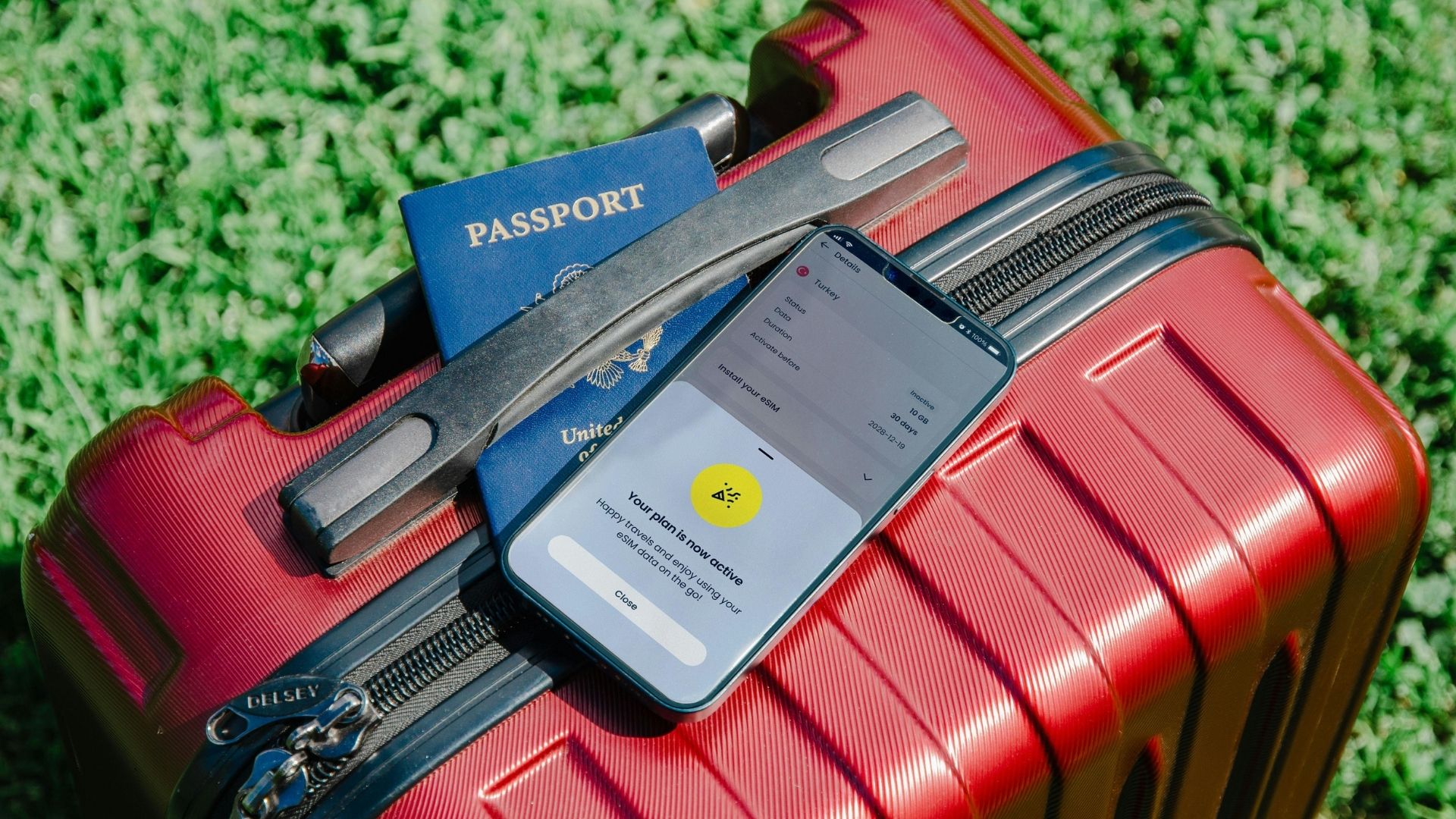
An eSIM is a digital SIM card built directly into your phone. There's no physical chip to swap. You buy a data plan from a travel eSIM provider, scan a QR code, and the profile installs onto your device.
Think of it like downloading a temporary SIM for your trip.
You can store multiple eSIM profiles on one phone and switch between them. Most modern iPhones (XS and later), Samsung Galaxy and Pixel devices support eSIM. If you're not sure whether your phone is compatible, check your settings under "Mobile Data" or "SIM & Network."
How a Travel eSIM Actually Works
- Choose a travel eSIM provider and select a plan for your destination.
- Complete the purchase on your phone or laptop before you leave.
- Scan the QR code you receive by email (or enter the details manually).
- The eSIM profile installs on your device.
- Activate it when you land, or set it to activate automatically on arrival.
That's it. Five to ten minutes of setup, and you're sorted before you even reach the airport.
Roaming vs eSIM: The Honest Comparison
Cost: Where Each Option Makes Sense
This is the biggest factor for most UK travellers.
Within Europe: Many UK networks still include a roaming allowance for European destinations, though the rules vary by provider. If your plan covers it, roaming in Spain, France, Italy or Greece costs you nothing extra. A travel eSIM would be an unnecessary expense in that case.
Outside Europe: This is where roaming gets painful. In the US, Japan, Thailand, Australia or Morocco, UK networks typically charge a daily roaming fee (often £2 to £6 per day depending on your plan) or a per-MB rate. A two-week trip can add a significant chunk to your bill.
A travel eSIM for those same destinations usually offers a fixed data package at a predictable price. You know exactly what you're spending before you leave.
Simplicity: Setup and Day-to-Day Use
Roaming wins on convenience. There's nothing to install, nothing to configure. Your phone connects to a local network the moment you switch it on abroad.
An eSIM requires a small amount of prep before your trip. But once it's installed, using it is just as seamless as roaming. The setup is a one-off effort, not an ongoing hassle.
Network Quality and Coverage
Roaming quality depends on which local operator your UK network has partnered with in each country. That partner isn't always the strongest network available.
Travel eSIM providers often select the best-performing local operators for each destination. In my experience, this can mean better signal in rural areas or less congested networks in busy tourist spots. Not guaranteed, but worth knowing.
Multi-Country Trips
If you're moving through several countries on one trip, roaming outside Europe can become complicated. Different daily rates per country, charges stacking up, and the risk of accidentally using data in a country you didn't account for.
Many travel eSIM providers offer regional or multi-country plans: one purchase, one data allowance, covering multiple destinations. For a road trip through Southeast Asia or a multi-stop itinerary in the Americas, that's a significant advantage.
Side-by-Side: Roaming vs eSIM
| Factor | Roaming | Travel eSIM |
|---|---|---|
| Setup required | None, automatic | QR code scan before departure |
| Cost in Europe | Often included in UK plan | Unnecessary if roaming is covered |
| Cost outside Europe | Can be high, varies by plan | Fixed price, known upfront |
| Your UK number | Stays active | Different number (but you can run both) |
| Multi-country coverage | Depends on network agreements | Often available as a single plan |
| Phone compatibility | All phones | eSIM-compatible phones only |
| Cost predictability | Variable outside Europe | Fixed from purchase |
| Physical SIM needed | Yes | No |
When Roaming Is the Right Call
You're Staying in Europe
If your UK plan includes a roaming allowance for European destinations, and you're heading to Spain, Portugal, Italy, Greece, the Netherlands or similar, roaming is almost certainly your best option. It's free within your existing plan, it's automatic, and you keep your UK number throughout.
Check your network's website before you go. Look for terms like "roam like home," "Europe zone" or "inclusive roaming destinations." If your destination is on the list, you're sorted.
Short Trips with Minimal Data Needs
Heading to New York for a long weekend? If you only need Google Maps and the occasional message, the daily roaming charge from your UK network might be perfectly reasonable for two or three days.
In that case, the effort of setting up a travel eSIM probably isn't worth it. Just check the daily rate, do the maths, and decide.
When a Travel eSIM Is the Better Option
You're Travelling Outside Europe
This is the scenario where a travel eSIM earns its place. The US, Canada, Japan, Thailand, Australia, the UAE, South Africa: destinations where UK roaming charges can be steep.
A travel eSIM gives you a fixed data allowance at a price you've agreed to before you leave. No surprise charges on your next phone bill. No mental arithmetic every time you open an app.
Providers like Airalo and Yesim are popular options that UK travellers mention frequently on forums and Reddit threads. They cover most major destinations and offer a range of data packages to suit different trip lengths and usage habits.
Longer Trips or Heavy Data Use
Spending three weeks abroad? Working remotely? Using GPS navigation all day, uploading photos, joining video calls? Roaming charges would stack up fast.
A travel eSIM with a generous data allowance is far more cost-effective for extended trips. You buy what you need, use it, and top up if necessary.
Visiting Multiple Countries Outside Europe
A single regional eSIM covering several countries is one of the most practical things about travel eSIMs. You don't need to buy a local SIM at every border crossing or manage multiple daily roaming charges across different countries.
For multi-stop trips through Asia, Latin America or the Middle East, a regional eSIM plan is usually the cleanest solution.
You Want to Keep Your UK Number Active Too
This is something a lot of travellers don't realise is possible. If your phone supports dual SIM (a physical SIM plus an eSIM), you can run both at the same time.
Keep your UK SIM active for calls and texts. Use the eSIM for data. You get the best of both options without carrying two phones or swapping chips at the airport.
How to Decide in Under a Minute
Use this as your quick reference before any trip:
- Destination is in Europe and your UK plan includes roaming: use roaming. Done.
- Destination is outside Europe, short trip, light data use: check your network's daily roaming rate. If it's reasonable for your trip length, roaming may be fine.
- Destination is outside Europe, longer trip or regular data use: get a travel eSIM. Fixed cost, no surprises.
- Multiple countries outside Europe in one trip: get a regional travel eSIM. One plan, one price, no hassle at each border.
- You need your UK number to stay reachable: use both. eSIM for data, UK SIM for calls and texts.
If you've decided a travel eSIM is the right move, the next step is comparing what's available for your specific destination. Data allowances, validity periods and network quality all vary between providers.
Our eSIM comparator lets you filter by country and find a plan that matches your actual usage, without wading through dozens of options manually. It's what I use before every trip outside Europe.
Common Mistakes UK Travellers Make
Assuming Roaming Is Always Included in Europe
Post-Brexit, this is no longer guaranteed. Most major UK networks still offer European roaming, but the terms differ. Some cap the data you can use abroad. Some charge a daily fee even within their "Europe zone." Read the small print before you rely on it.
Forgetting to Check eSIM Compatibility
Not every phone supports eSIM. Older devices, some budget Android phones, and phones that were network-locked may not be compatible. Check before you buy a travel eSIM plan.
Buying a Physical SIM at the Airport
It works, but it's rarely the best value. Airport SIM cards are convenient, but they're almost always more expensive than buying a travel eSIM in advance. You also lose time queuing at a kiosk when you could just walk straight through.
Not Disabling Roaming on Your UK SIM When Using an eSIM
If you're using an eSIM for data but your UK SIM is still active with roaming enabled, your phone might pull data through the UK SIM without you noticing. Turn off data roaming on your UK SIM in your settings. You'll still receive calls and texts, but data will only go through your eSIM.
Underestimating How Much Data You'll Use
GPS navigation, streaming music, uploading photos, checking emails: it adds up faster than you'd expect. If you're buying a travel eSIM, be realistic about your usage. A small package might look appealing, but running out of data halfway through a trip is frustrating.