How to Get a Real American Phone Number from the UK
If you need a genuine +1 number that can actually receive calls and SMS, there are a few realistic options from the UK.
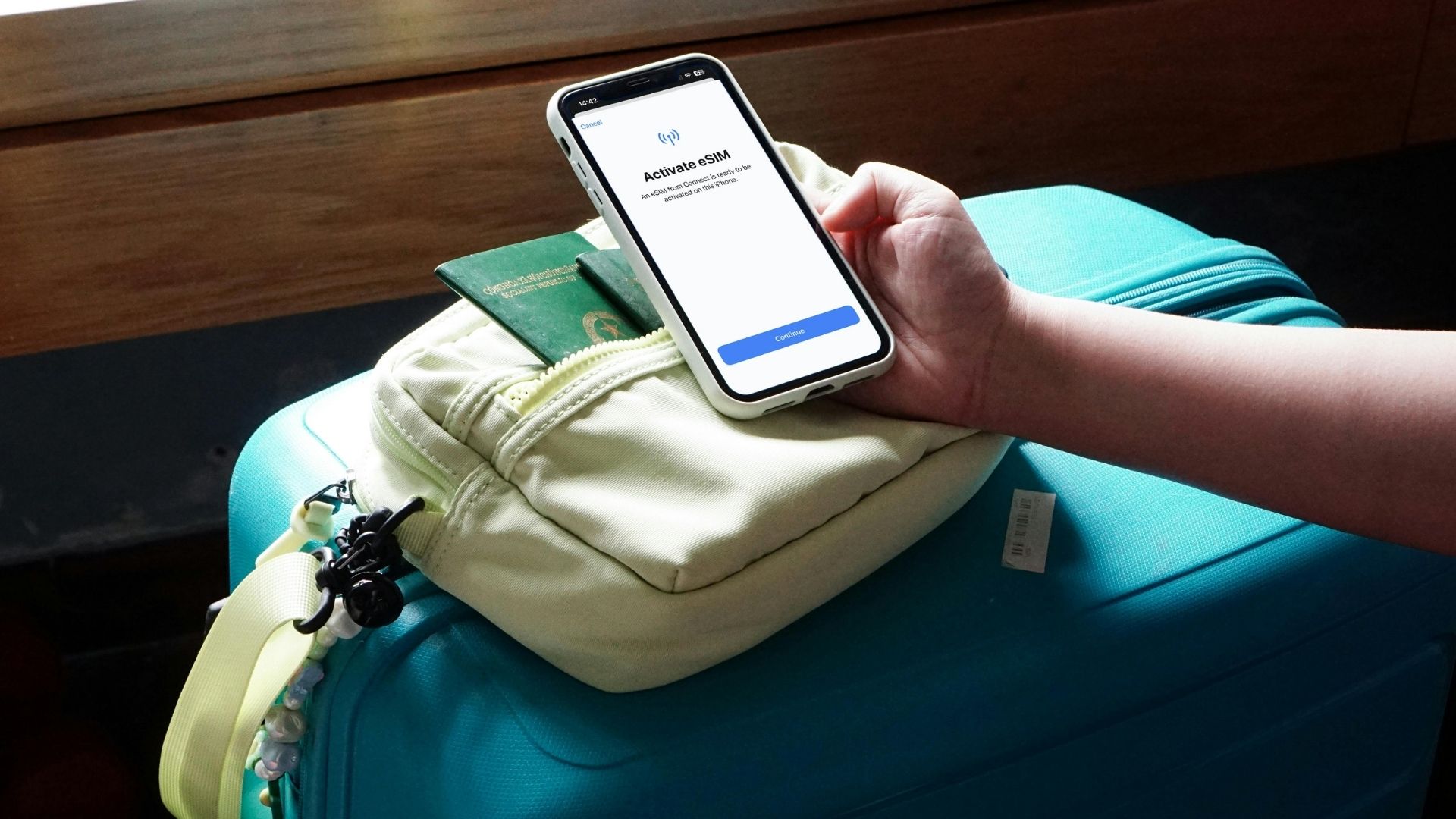
Option 1: eSIM with an Integrated US Number
This is the most straightforward route if you don't want to deal with physical SIM cards or complex VoIP setups.
Services like Saily (from the Nord Security group, the same company behind NordVPN) provide a permanent US +1 number tied to your account. The number stays the same even if you change your data plan. You can call, receive calls, send and receive SMS, all from the app.
The process works like this:
- Download the Saily app on iOS or Android.
- Create an account and subscribe to a Saily data plan (the number must be linked to a data plan).
- Add the US number option from within the app.
- Add a calls and SMS plan, which is priced separately.
- Complete the mandatory identity verification in the app.
- Set Saily as your primary line in your phone settings.
- Your +1 number is active. You can call, receive calls, and send SMS directly from the app.
A few honest caveats:
- There is no +44 number option. If you need a UK virtual number, Saily isn't the right tool.
- Identity verification is required. This is not an anonymous number.
- The number alone isn't enough. You need both a data plan and a calls/SMS plan for it to function.
Option 2: Google Voice
Google Voice gives you a real US number for free. The problem from the UK: you need an existing US number to sign up. If you're starting from zero, you're stuck in a loop.
It's a solid option if you already have temporary US access (travelling there, borrowing a number briefly), but not a practical starting point from the UK.
Option 3: VoIP Providers
Services like Zadarma or Ringover offer US numbers as part of their business communication packages. They're more suited to companies wanting a US presence than to individual travellers or people needing a number for personal use.
Option 4: US Prepaid SIM on the Ground
If you travel to the US regularly, buying a prepaid SIM from T-Mobile or AT&T on arrival is still a valid option. You get a real number with proper local coverage. The limitation is obvious: you need to be physically in the US to buy it.
If that matches what you need, you can try Saily's US number. The code LEZBROZ gets you -5%. One useful detail: the link lands on Saily's homepage, and the number add-on is taken out afterwards inside the app.
What an American Phone Number Actually Looks Like
If you've ever tried to sign up for a US streaming service, a fintech app, or a business platform from the UK, you've hit the same wall: the form asks for an american phone number and rejects your +44.
Before you reach for a random number generator, it helps to understand the format. Then you can decide whether you need a real line or just a valid example for testing.
A US number has three parts:
- +1: the country code for the United States (shared with Canada and several territories).
- 3 digits: the area code, tied to a specific geographic region.
- 7 digits: the local number, split into a 3-digit exchange and a 4-digit subscriber number.
Total: 10 digits after the +1, or 11 digits including it.
A real example written in international format: +1 212 555 0100.
The same number in standard American notation: (212) 555-0100.
On most online forms, the safest format is no spaces or hyphens: +12125550100.
The NANP: Why the USA and Canada Share a +1
The NANP stands for North American Numbering Plan. It's the integrated dialling system that covers the USA, Canada, Puerto Rico, Jamaica, and about 20 other territories. They all share the +1 country code.
This matters for two reasons:
- A +1 number isn't automatically American. A Canadian number looks identical.
- When US services ask for a "US phone number", they usually mean a number with a recognised US area code, not just any +1.
The NANP was introduced in 1947 and is still managed today by the North American Numbering Plan Administration (NANPA).
Area Codes: What the First 3 Digits Tell You
The area code is the geographic identifier. Each region has one or more assigned codes. Large cities often have several, added over time as demand grew.
Here are the area codes for the main US cities:
| City | State | Area Code(s) |
|---|---|---|
| New York | NY | 212, 646, 332, 917 |
| Los Angeles | CA | 213, 323, 310, 424 |
| Chicago | IL | 312, 773, 872 |
| Houston | TX | 713, 281, 832 |
| Miami | FL | 305, 786 |
| San Francisco | CA | 415, 628 |
| Las Vegas | NV | 702, 725 |
| Washington D.C. | DC | 202 |
| Boston | MA | 617, 857 |
| Seattle | WA | 206, 253 |
One thing worth knowing: area codes no longer guarantee someone physically lives in that region. Mobile numbers in the US are portable, so a person with a 213 (Los Angeles) code might be based in New York.
The 555 Number: Why Films Always Use It
You've seen it in every American film. The detective scribbles down 555-0147. The villain calls 555-0199. It's never a real number, and that's entirely intentional.
The range 555-0100 to 555-0199 is officially reserved by the NANP for fictional use. No subscriber is ever assigned one of these numbers. Film studios use them to avoid millions of viewers ringing a real person after watching a scene.
If you're testing a form or an interface and need a structurally valid US number that won't accidentally reach anyone, a 555 number in that range is the standard choice.
Number Generators: Useful for Testing, Useless for Verification
A US phone number generator produces numbers that match the NANP format. The digits are valid, the area code exists, the structure is correct.
What a generated number cannot do:
- Receive an SMS
- Receive a call
- Pass any real verification that sends a code
If you're a developer checking whether your input field accepts the correct format, a generated number does the job. If you're trying to create an account on a US platform that sends a verification code, a generated number is useless. You'll wait for a code that will never arrive.
The same logic applies to random number tools. They produce structurally valid digits, nothing more.
Free Shared Numbers: The Risk Most People Miss
Several websites offer a free american phone number for receiving SMS. The catch is buried in how they work.
These services assign one number to thousands of users simultaneously. Every SMS sent to that number appears on a public page, visible to anyone who visits the site.
The practical consequence: if you use one of these numbers to sign up for Netflix, Amazon, or any account that sends a verification code, anyone else on that page can read your code in real time. Someone can complete your registration before you do, or take over an account you've just created.
For testing a form with a dummy number, shared services are harmless. For anything involving a real account, they're a genuine security risk.
Calling an American Number from the UK
To call a US number from a UK phone, dial +1 followed by the 10-digit number. The + replaces the international dialling prefix (00 in the UK).
Example: to call a New York number, you'd dial +1 212 XXX XXXX.
Time zones matter. New York (Eastern Time) is 5 hours behind London in winter and 6 hours behind in summer, due to the slight mismatch in when the clocks change. Los Angeles (Pacific Time) is 8 hours behind in winter and 9 hours behind in summer.
Calling at 9am from London means calling at 4am in New York. Worth checking before you dial.
When You Actually Need a Real +1 Number
Here's a quick breakdown of use cases and whether a real number is necessary:
| Use case | Real +1 needed? |
|---|---|
| Testing a form's input validation | No, a generated number works |
| Signing up for a US streaming service | Yes |
| Receiving a 2FA or OTP code | Yes |
| Filling in a fictional or demo field | No |
| Creating a WhatsApp account with a US number | Yes |
| Checking what a US number looks like | No |
If your use case sits in the "yes" column, a generated or shared number will waste your time. You need a line that can actually receive an SMS.
If you want to compare eSIM options that include a US number, the eSIM comparator lists current providers side by side.