


If you have been searching for a Nomad eSIM review before your next trip, you are in the right place. I have tested Nomad across several countries over the past couple of years, and this is my honest, no-fluff take on whether it is actually worth your money as a UK traveller.
Spoiler: it is a genuinely good product. But it is not perfect, and there are a few things I wish someone had told me before my first purchase. Let me walk you through everything.
What Is Nomad eSIM and Who Is It For?
The Provider Behind the Product
Nomad is a travel eSIM provider focused on prepaid data for international travellers. The company sits in a market that has grown massively over the last few years, as more smartphones support eSIM technology and more people want to avoid the chaos of buying a local SIM at the airport.
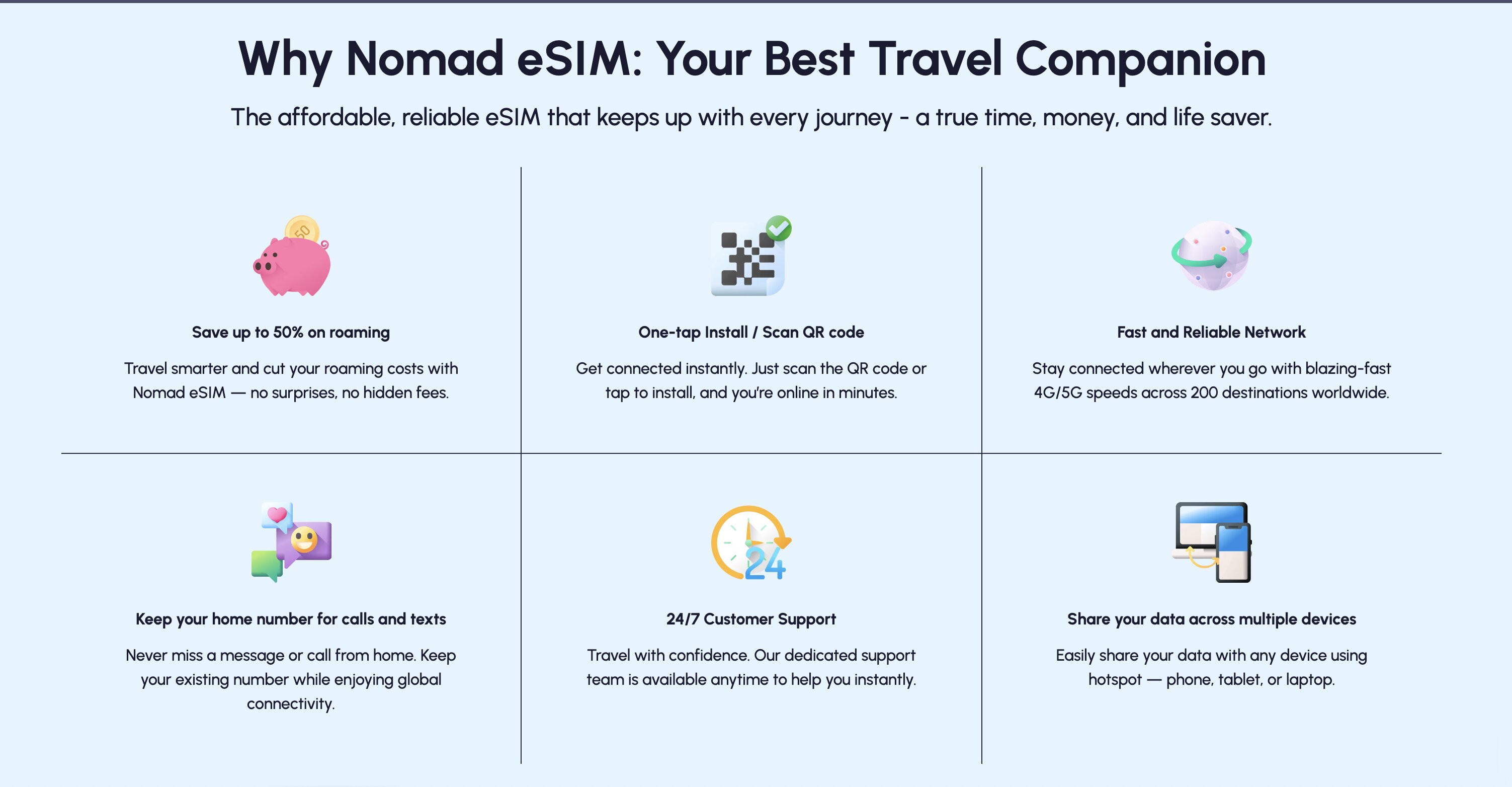
The pitch is simple: buy a data plan before you fly, scan a QR code, and you are online the moment you land. No queuing at a kiosk, no worrying about losing a tiny SIM card, no roaming charges quietly stacking up on your home network bill.
For UK travellers specifically, this matters a lot. Since Brexit, the free EU roaming that came with most UK mobile contracts disappeared. Providers like EE, O2, Vodafone and Three have reintroduced varying levels of EU roaming, but the charges and fair use limits vary wildly. A travel eSIM from Nomad sidesteps all of that.
What "Data Only" Actually Means
Nomad is a data-only provider. That means no phone number, no voice calls, no SMS. You get mobile internet, and that is it.
For most travellers in 2026, that is genuinely fine. WhatsApp calls, FaceTime, Google Maps, Instagram, emails: everything you actually need on a trip runs over data. The only time it becomes a limitation is if you need a local number for things like two-factor authentication texts or calling a local restaurant.
Worth knowing before you buy, not a dealbreaker for most people.
My First Real Test: Using Nomad in Portugal
Setting It Up Before the Flight
I first tried Nomad ahead of a two-week trip to Lisbon and the Algarve. I bought a regional Europe plan through the app, received the QR code by email within a few minutes, and installed it on my iPhone at home the evening before departure.
The whole process took about four minutes. That includes downloading the app, buying the plan, scanning the QR code and setting the Nomad eSIM as my default data line in my phone settings.
One thing I always tell people: install your eSIM before you leave the UK. You need a Wi-Fi connection to download the eSIM profile. Once it is installed, you do not need Wi-Fi to activate it on arrival. Do it at home, not at the gate.
On the Ground in Lisbon
The eSIM connected automatically when I landed. No fiddling with settings, no call to a support line. I was on 4G before I reached the luggage carousel.
Speed was solid throughout the trip. Streaming music, uploading photos to Google Drive, using Maps for navigation around narrow Alfama streets: all worked without issues. I never felt throttled or slowed down in a noticeable way.
The app showed my remaining data clearly, which I appreciated. I used about 3.5 GB over two weeks, well within the plan I had bought.
Round Two: Testing Nomad in a More Demanding Destination
Pushing the Coverage Further
After Portugal, I tried Nomad on a longer trip that took me through Japan and then briefly into South Korea. This is where travel eSIMs get properly tested: dense urban environments with high data demand, mixed with rural areas where coverage can drop.
Japan was impressive. Tokyo, Kyoto, Osaka: fast and consistent 4G throughout. Even on rural train lines between cities, I had a usable connection most of the time. That matters when you are navigating in a country where you cannot always read the signs.
South Korea was equally strong. Seoul in particular had excellent speeds. I did not manage to get 5G on my plan, but 4G was more than enough for everything I needed.
Where Things Got Trickier
I will be honest: connectivity in more remote areas was patchier. Small villages, mountain areas, some coastal spots: coverage dropped noticeably. That is not unique to Nomad, it is a reality of how travel eSIMs work. They connect to local partner networks, and those networks have the same gaps as any local operator.
If your trip is mostly cities and popular tourist areas, you will be fine. If you are heading somewhere genuinely off the beaten track, check the coverage map on Nomad's website before buying.
Nomad's Plans and Price Points
Three Types of Plans to Know
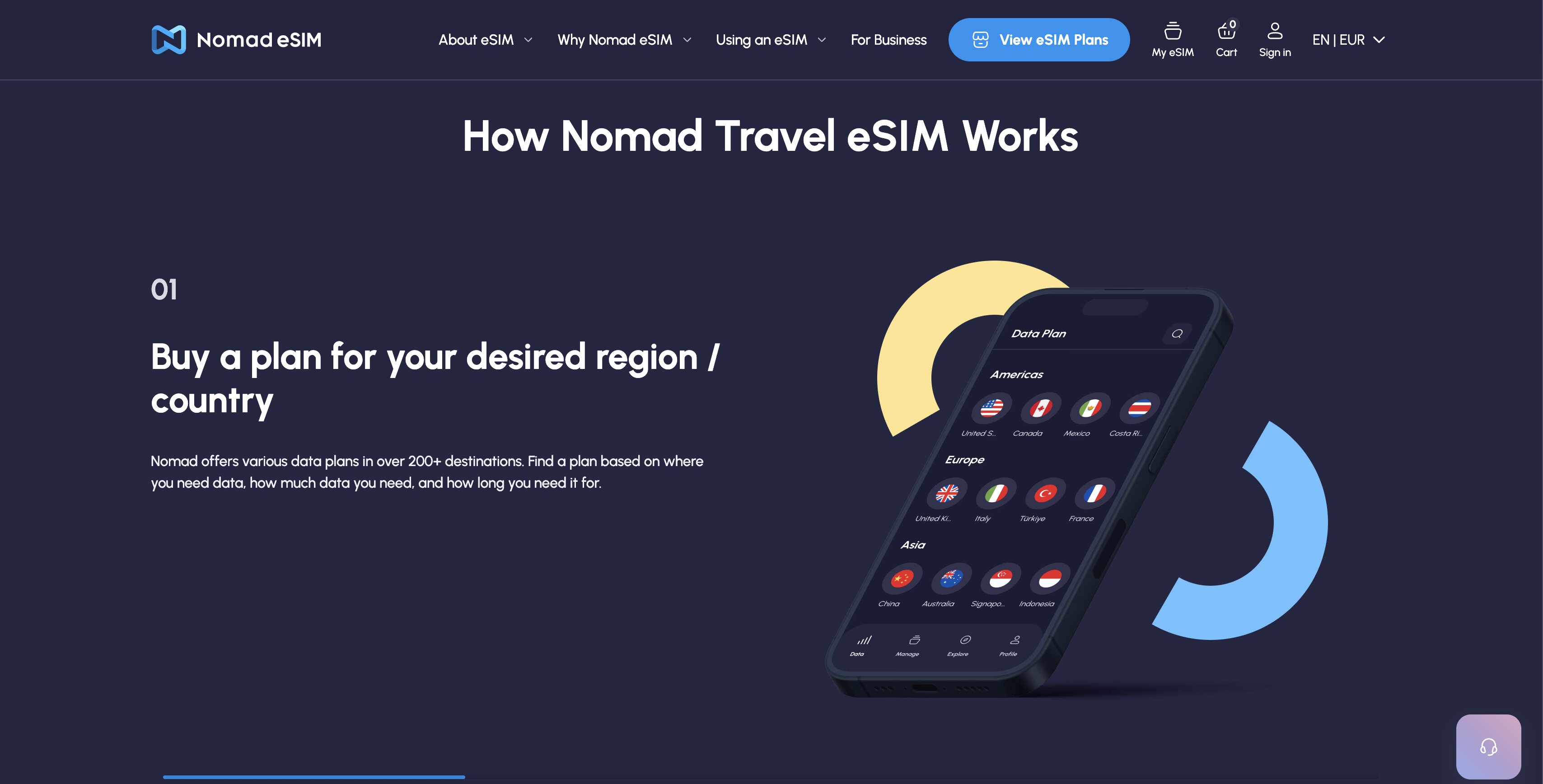
Nomad offers three plan structures, and choosing the right one makes a real difference to what you pay.
Local plans cover a single country. These tend to be the most affordable option when you are staying in one place, especially for popular destinations like the US, Japan, Australia or most of Europe.
Regional plans cover a group of countries under one plan. Nomad has regions including Europe, Asia-Pacific, Latin America, USA and Canada, and Africa, Middle East and India. If you are doing a multi-country trip, a regional plan almost always works out cheaper than buying separate local plans for each country.
Global plans cover multiple regions under a single eSIM. Useful for complex itineraries, but the price per GB is higher. Worth it for convenience on a trip that spans several continents, less worth it if you are only visiting two or three countries.
What to Watch on Pricing
I am not going to list specific prices here because they change regularly. What I will say is this: the price per GB is the number that matters, not the headline plan price.
On popular destinations like the US, Japan and most of Western Europe, Nomad is competitive. On some less common destinations, the price per GB can be higher than what you would find with Airalo or a few other providers.
My advice: before you buy, check Nomad's price for your specific destination and compare it quickly with one or two alternatives. It takes five minutes and can save you a few pounds on a larger data plan.
Billing is in USD. For UK travellers, that means your bank or card provider will apply their exchange rate and possibly a foreign transaction fee. Factor that in when comparing prices.
The App Experience: Day to Day
What the App Does Well
The Nomad app is clean and functional. It does not try to do too much, which I actually appreciate. The main screen shows your active plan, how much data you have used and how much is left, and how many days remain on the plan.
You can top up or buy a new plan directly from the app in a couple of taps. That is genuinely useful when you are mid-trip and realise you are going to run out of data before your flight home.
A few features I use regularly:
- Real-time data tracking: you can see your consumption updating as you use it.
- Purchase history: handy if you travel to the same destinations repeatedly and want to remember which plan you bought last time.
- Low data notifications: the app alerts you when you are approaching your limit.
Where the App Could Improve
The app is not the most feature-rich on the market. Airalo's app, for comparison, has a slightly broader range of functions and feels a bit more polished in places.
That said, I have never had the Nomad app crash on me, fail to load my plan details, or give me inaccurate data readings. Reliability matters more than extra features when you are relying on it in an unfamiliar country.
Compatibility: Will It Work on Your Phone?
Devices That Support Nomad
Nomad works with any unlocked smartphone that supports eSIM technology. The main compatible devices include:
- iPhone: XS and later (so anything from 2018 onwards)
- Samsung Galaxy: S20 series and later, plus recent Z Fold and Z Flip models
- Google Pixel: Pixel 3 and later
- Other Android: select models from Motorola, Oppo and others, depending on region and variant
Two things to check before you buy:
- Your phone supports eSIM (check Settings or your manufacturer's website)
- Your phone is unlocked and not tied to a specific network
That second point catches people out more than you might expect. If you bought your phone on a contract with EE, O2, Vodafone or Three and it has not been unlocked, it may not accept a third-party eSIM. Contact your network to unlock it, usually free once your contract minimum term is up.
Nomad has a compatibility checker on their website. Use it if you have any doubt.
Customer Support: Honest Assessment
How to Get Help
Support is available via live chat and email. There is no phone line. For most issues, the chat is responsive during business hours and the agents know the product well.
The help centre and FAQ on the Nomad website are genuinely useful for common problems: eSIM not activating, connection dropping, how to set up the APN (that is the network access point, basically a setting that tells your phone how to connect to the mobile network). I have solved most minor issues myself using those resources.
The Limitation Worth Knowing
If something goes wrong at 2am on a Sunday when you have an early flight, you may be waiting a while for a response. That is the reality of online-only support.
In practice, most eSIM issues are either solved quickly or are related to device compatibility problems that support cannot fix remotely anyway. But if having a phone number to call in an emergency is important to you, Nomad is not going to give you that.
What UK Travellers Are Saying
Reviews and Ratings
Nomad holds a strong rating on Trustpilot, sitting around 4.3 out of 5 based on a significant volume of reviews. For context, that is a solid score in the travel eSIM sector, where expectations are high and people are quick to leave negative reviews when something goes wrong abroad.
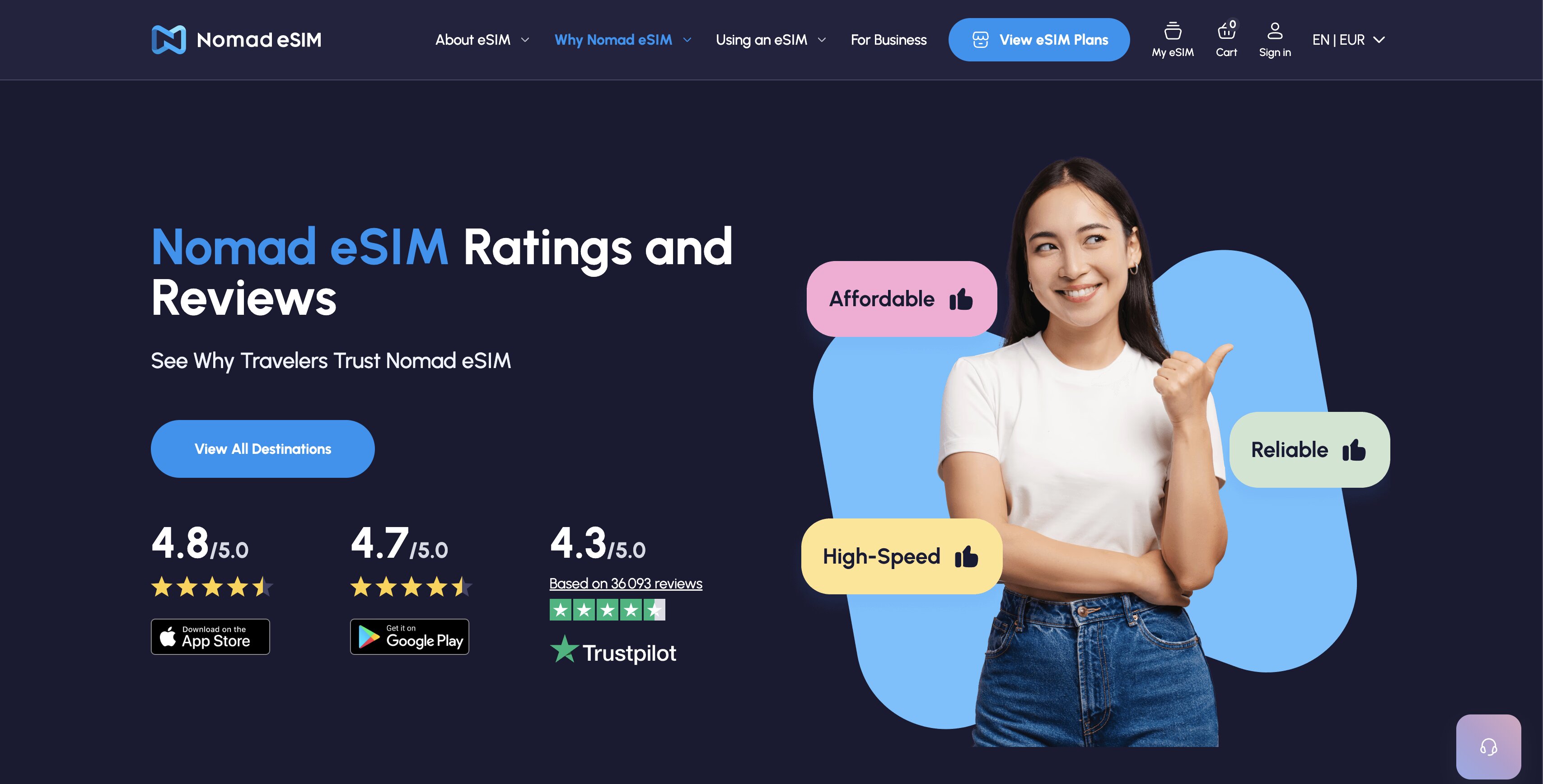
Positive reviews consistently mention the same things: easy setup, reliable connection, and the convenience of managing everything from the app. Negative reviews tend to focus on device compatibility issues or slower-than-expected support responses.
« Really impressed with how easy it was to set up. Scanned the QR code the night before my flight and it connected straight away when I landed. Used it across three countries in two weeks without a single issue. Will definitely use Nomad again. »
Verified Trustpilot review
Common Complaints Worth Noting
A few recurring themes in the less positive reviews:
- Compatibility surprises: some users found their phone was not compatible despite believing it was. Always verify before purchasing.
- Variable speeds by country: the 4G connection quality depends on which local partner network Nomad uses in each destination. Some are faster than others.
- Support wait times outside business hours: as mentioned above, this is the main operational weakness.
None of these are dealbreakers, but they are worth knowing so your expectations are set correctly.
Nomad vs Airalo: The Comparison UK Travellers Actually Want
Side by Side
The question I get asked most often is: Nomad or Airalo? Both are legitimate, well-reviewed providers. Here is how they compare on the factors that matter most:
| Criteria | Nomad | Airalo |
|---|---|---|
| Billing currency | USD | USD |
| App quality | Clean, functional | More features, slightly more polished |
| Destination count | 200+ | 200+ |
| Regional plans | Yes | Yes |
| Price per GB | Competitive, varies by destination | Often slightly cheaper on popular routes |
| Promo codes | Not regularly available | Frequent promo codes |
| Customer support | Chat and email | Chat and email |
| Trustpilot rating | ~4.3 | ~4.4 |
Airalo has a slight edge on price for some popular destinations, partly because they run promo codes regularly. If you find a valid Airalo code before your trip, it can make a meaningful difference on the first purchase.
Nomad's advantage is its simplicity and reliability. The app is easier to navigate for first-time eSIM users, and I have found the connection quality consistent across the destinations I have tested.
Which One Should You Pick?
If you are new to travel eSIMs and want the least complicated experience, Nomad is a great starting point.
If you are a frequent traveller who has already used eSIMs and you want to squeeze the best price per GB, it is worth comparing both for your specific destination before buying.
For multi-country European trips, Nomad's regional plans are genuinely well-priced and the setup is seamless. That is where I reach for Nomad first.
Is Nomad eSIM Worth It for UK Travellers in 2026?
The Case For Nomad
Nomad makes sense for you if:
- You are travelling to Europe, the US, Japan, Australia or other well-covered destinations
- You want a simple, reliable setup without technical headaches
- You are doing a multi-country trip and want one regional plan to cover it all
- You are new to eSIMs and want an app that is easy to understand
- You want to avoid roaming charges from your UK network without the hassle of a physical SIM
When to Look Elsewhere
Nomad is not the right call if:
- You are heading somewhere off the beaten track with limited coverage (check their map first)
- You want the absolute lowest price per GB and are willing to shop around
- You need a local phone number for your destination
- You need phone support available around the clock
In those cases, it is worth comparing Nomad against Airalo, Holafly or a local SIM option for your specific destination.
My Overall Verdict
Nomad is a reliable, well-designed travel eSIM that does exactly what it says. The setup is fast, the app works well, the coverage is solid in the destinations most UK travellers visit, and the pricing is transparent.
It is not the cheapest option in every situation, and the online-only support is a genuine limitation. But for the vast majority of trips, Nomad delivers a smooth, stress-free connectivity experience.
I have used it on multiple trips now and I keep coming back to it. That says more than any rating.


