


If you've been searching for an honest Roamless Review, you're in the right place. I've tested a lot of travel eSIMs over the years, from fixed bundles to pay-as-you-go setups, across destinations ranging from Southeast Asia to the Middle East and the US. Roamless caught my attention because it does something most travel eSIMs simply don't: it combines data, a phone number, calls and SMS in one app, on one balance. Here's my full take for 2026, written specifically for UK travellers.
TL;DR: Roamless in 60 Seconds
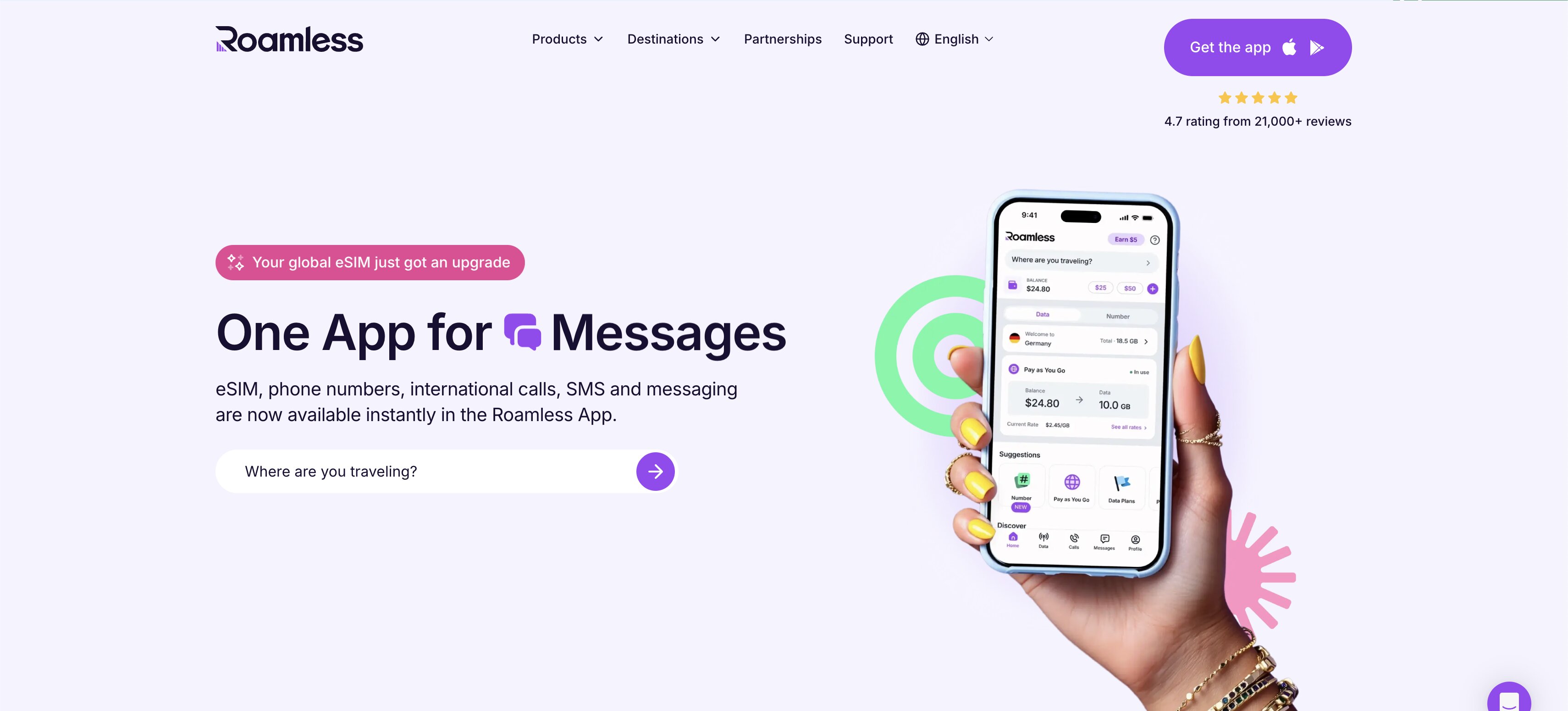
Roamless is a travel eSIM with a twist. Instead of buying a fixed data bundle that expires whether you use it or not, you load up a balance (in USD) and pay only for the data you actually consume. Your leftover credit carries over to your next trip.
What makes it stand out: it's not data-only. You get a phone number, international calls and SMS baked in, all managed from one clean app.
It covers 200+ destinations on a single reusable eSIM you install once and keep. For UK travellers, the main thing to watch is the USD billing, which can add a small conversion cost depending on your card.
Best for: multi-destination travellers, light-to-moderate data users, frequent flyers who want one eSIM for everything.
Not ideal for: heavy data users staying in one country, or anyone without a fee-free card who wants to avoid currency conversion costs.
What Is Roamless?
The Company and Its Approach
Roamless is a travel connectivity provider built around one idea: you should only pay for what you actually use. It's not a traditional mobile operator. Instead, it works as a network aggregator, partnering with local operators in each country to connect you to the best available network wherever you are.
The name says it all. The goal is to make roaming feel like being at home: no bill shock, no complicated setup, no throwing away unused data at the end of a trip.
For UK travellers used to paying steep roaming charges or scrambling for a local SIM at the airport, that's a genuinely appealing proposition.
How It Differs from Most Travel eSIMs
Most travel eSIMs are data-only. You buy a bundle, you use it, it expires. Roamless takes a different approach on two fronts.
First, the pay-as-you-go model: you load a balance and spend it as you go. No expiry, no waste. You can also opt for a fixed data plan if you prefer a set allowance, so you're not locked into one model.
Second, the all-in-one feature set: alongside data, Roamless gives you a phone number, international calls and SMS. That's genuinely rare in the travel eSIM market, where most providers stop at data.
My Experience with Roamless
Getting Set Up
Setup is straightforward. You download the Roamless app (available on the App Store and Google Play), create an account, load your balance, and install the eSIM directly from the app. No QR code hunting required, though that option exists too if you prefer it.
The eSIM installs once and stays on your device. Next trip, you just top up your balance and you're ready to go. That's a proper quality-of-life improvement over buying a new physical SIM every time you land somewhere.
One thing worth knowing before you travel: when you arrive at your destination, it can take a few minutes for the connection to establish. In some cases, you'll need to go into your phone's network settings and manually select the Roamless eSIM as your data line. It's not complicated, but it's worth doing at home before you leave, not in a rush at Heathrow departures.
Day-to-Day Use
Once connected, the experience is clean. The app shows your remaining balance and data consumption in real time, which takes the anxiety out of monitoring your usage. You can top up on the go if you're running low, which I've had to do exactly once, after a heavy navigation day in a city I didn't know well.
The hotspot (tethering) function works, which is useful if you need to get a laptop online quickly. I've used it in airport lounges and hotel lobbies without any issues.
Calls and SMS: A Genuine Differentiator
This is where Roamless earns its place in my kit. Most travel eSIMs are data-only, which means you're relying on WhatsApp or FaceTime for calls. That works fine until you need to call a hotel, confirm a reservation, or receive a verification SMS for a banking app.
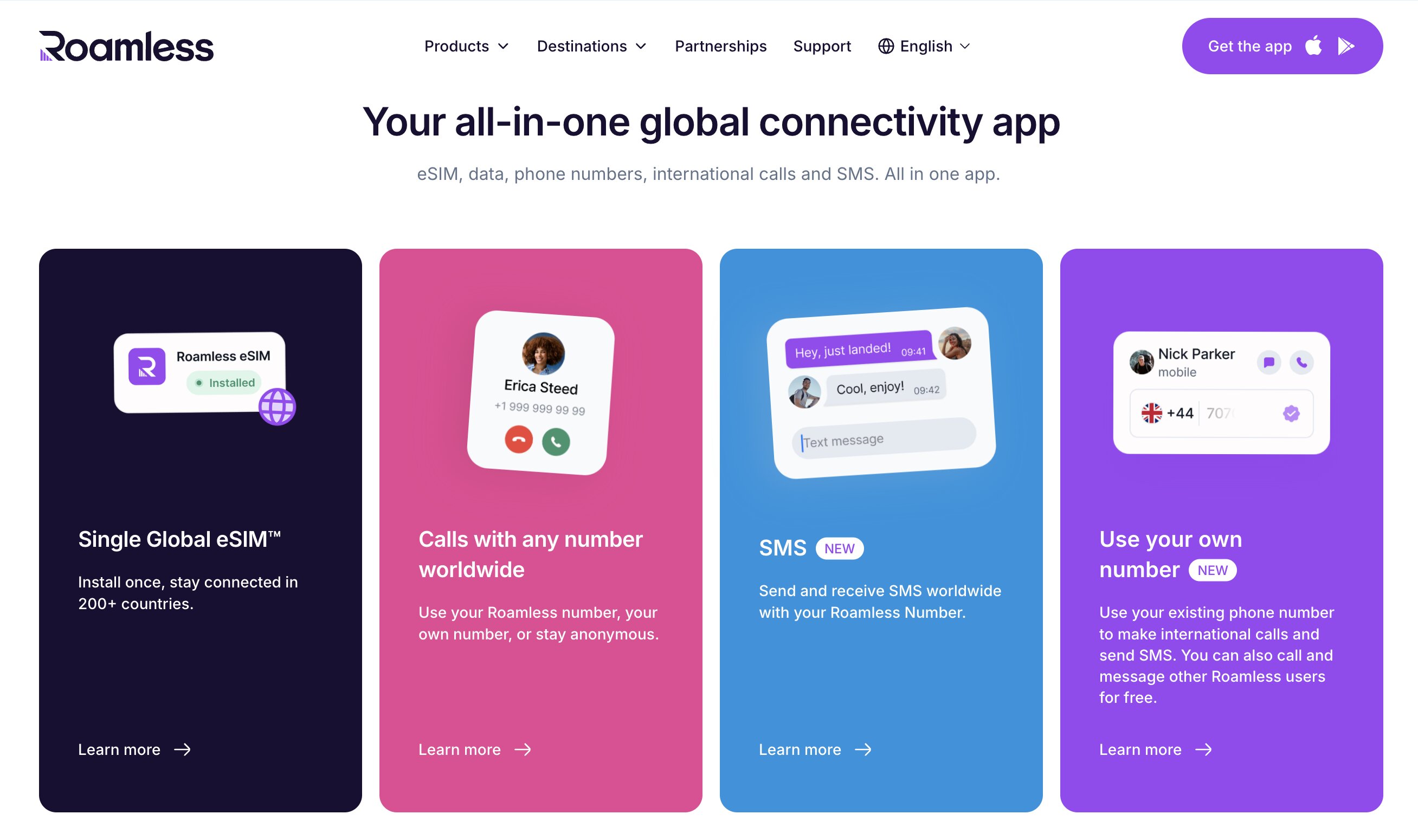
With Roamless, you get an actual phone number. You can make and receive calls, send and receive SMS, all from the same app and the same balance. You can use a Roamless number, your own number, or stay anonymous depending on the situation.
For full-time travellers or anyone who needs to stay reachable for work while abroad, this is a meaningful difference.
Ease of Use
The App
The Roamless app is one of the better travel eSIM apps I've used. It's logically laid out: balance front and centre, data usage clearly displayed, top-up straightforward. You're not digging through menus to find basic information.
It's available on both iOS and Android, and it receives regular updates, which suggests the team is actively maintaining it rather than leaving it to stagnate.
Installation: What to Know
A few practical points for UK users:
- Your phone must be eSIM compatible. Most iPhones from the XS (2018) onwards are fine. Samsung Galaxy S21 and above, Google Pixel 3 and above, and many recent Android devices also support eSIM.
- Your phone must be unlocked. If you bought your phone on a contract with EE, O2, Vodafone or Three and it's still locked to that network, a Roamless eSIM won't work. Check with your carrier if you're unsure.
- Some older or budget Android devices don't support eSIM at all. Worth double-checking before you buy.
Once installed, the eSIM stays on your device permanently. You don't reinstall it for each trip. That alone saves a surprising amount of faff.
Managing Your Balance
The pay-as-you-go model puts you in control, but it also means you need to stay on top of your balance. The app makes this easy, with real-time consumption tracking. You can set up top-ups in advance or add credit on the go.
The balance doesn't expire between trips, which is one of the genuinely useful features here. If you come back from a fortnight in Japan with credit left over, it's waiting for you when you head to New York three months later.
Data Plans and Pricing
Pay-As-You-Go vs Fixed Plans
Roamless gives you two ways to pay. The Roamless Credits model is pure pay-as-you-go: load a balance in USD, spend it as you consume data. The fixed data plan option works more like a traditional bundle: a set amount of data for a set price, valid for a set period.
For most travellers, the Credits model makes more sense. You only pay for what you use, and nothing expires. For a trip where you know you'll be using a lot of data consistently, a fixed plan might give you better value per GB.
What Does It Cost?
The per-GB rate varies by destination. That's the nature of pay-as-you-go: pricing reflects the local network costs in each country. Some destinations are very competitive. Others are pricier, particularly if you're in a market where local data is expensive anyway.
The honest comparison: if you're a light user (Maps, messaging, emails, occasional browsing), Roamless will almost certainly cost you less than a fixed bundle from a competitor, because you're not paying for data you don't use. If you're a heavy user streaming video or on video calls all day, a fixed high-volume bundle from a provider like Holafly may work out cheaper per GB.
My advice: estimate your typical daily data use, multiply by your trip length, and compare that against what a fixed bundle would cost. The maths usually makes the right answer clear.
The USD Billing Point
This is the one thing I'd flag specifically for UK travellers. Roamless bills in US dollars. When you top up from a UK bank card, your bank will apply its exchange rate and potentially a foreign transaction fee on top.
If you use a fee-free card (Monzo, Starling, Revolut, Wise), this is a non-issue. If you're paying with a standard Barclays, Lloyds or HSBC card, factor in an extra 2-3% on top of whatever you're loading. It's not a dealbreaker, but it's worth knowing upfront rather than being surprised on your statement.
Coverage and Network Performance
200+ Destinations
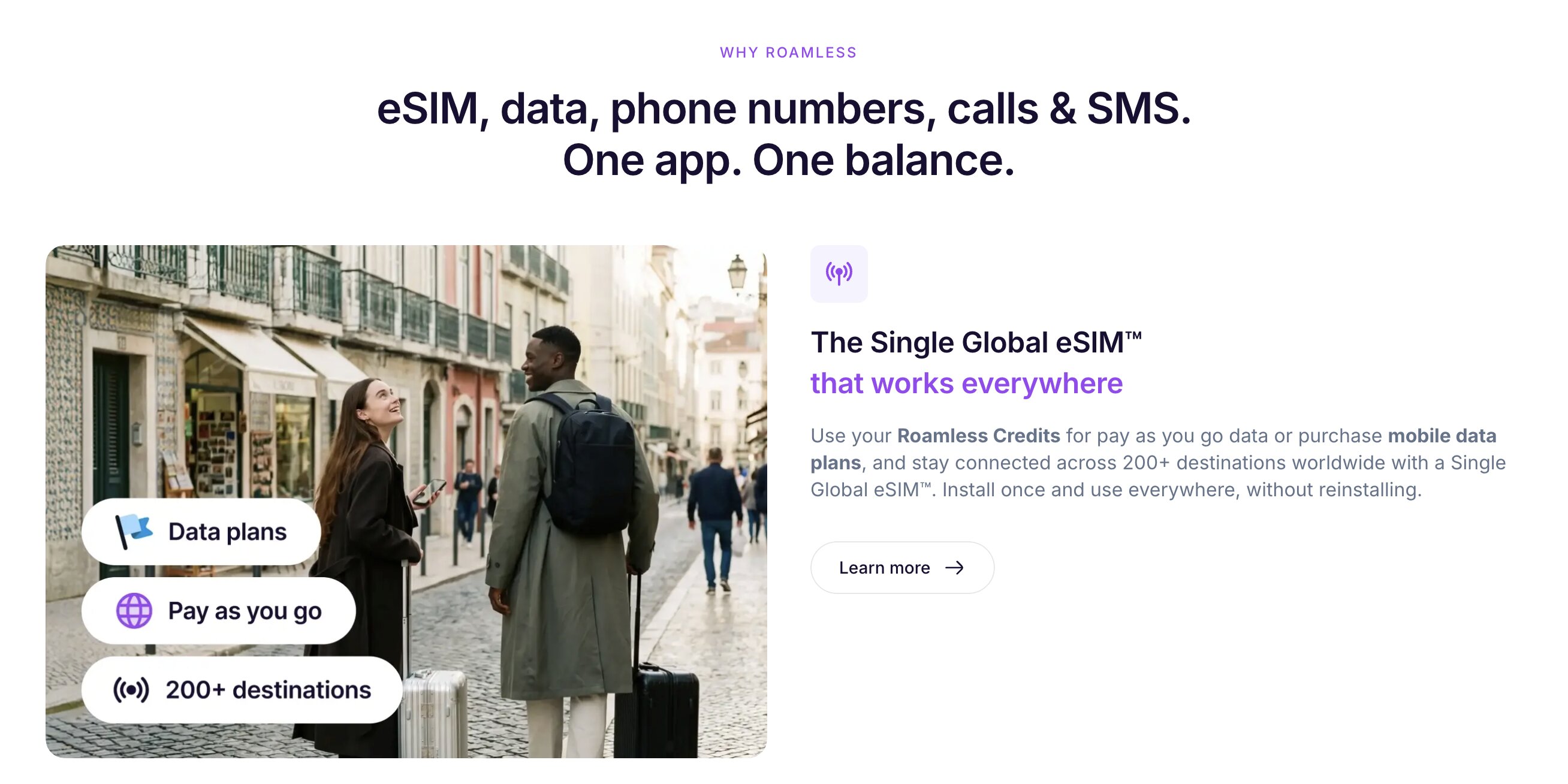
Roamless covers more than 200 destinations worldwide. For a multi-destination traveller, that's a significant practical advantage: one eSIM, one balance, no switching providers between countries.
Coverage spans Europe, North America, Asia Pacific, the Middle East, Latin America and parts of Africa. The list is broad enough that you're unlikely to find yourself without coverage on a mainstream travel itinerary.
Speed and Reliability
In most destinations, Roamless delivers 4G connectivity. 5G is available in select markets. For everyday travel use, 4G is more than adequate: Google Maps, streaming music, video calls, uploading photos to the cloud, all work without issues.
Speed in practice depends on the local partner network. Roamless doesn't own its own infrastructure: it connects you through local operators in each country. In major cities, performance is generally solid. In rural areas or less-developed markets, you may see slower speeds, which is true of any roaming eSIM, not just Roamless.
Checking Coverage Before You Travel
Before any trip, I'd recommend checking the Roamless app or website for your specific destination. The app shows which networks are available and what technology (4G/5G) you can expect. Takes two minutes and removes any uncertainty before you land.
International Calls with Roamless
How It Works
Most travel eSIMs stop at data. Roamless goes further. The app includes a calling feature that lets you make and receive international calls using your Roamless number, your own number, or anonymously. SMS works the same way: send and receive from within the app.
This is particularly useful for:
- Receiving two-factor authentication SMS from your bank or other services (a common pain point when travelling with a data-only eSIM)
- Calling hotels, restaurants or local services that don't use WhatsApp
- Staying reachable on a real phone number for work or family
The calls run over the Roamless network, not over your data connection, so they don't eat into your data balance in the same way a VoIP call would.
Compared to Using WhatsApp or FaceTime
WhatsApp and FaceTime are fine for keeping in touch with people who have those apps. They fall short the moment you need to call a landline, receive an SMS from a bank, or ring a local business. Roamless fills that gap in a way that data-only eSIMs simply can't.
For full-time travellers or digital nomads who need to stay genuinely reachable, this is a meaningful feature. For a two-week holiday where you'll mostly be on WhatsApp anyway, it's a nice-to-have rather than essential.
What UK Users Are Saying
Trustpilot Score
Roamless holds a strong rating on Trustpilot, with a consistent score around 4.5 stars across a substantial number of reviews. The pattern in positive reviews is consistent: satisfaction with the pay-as-you-go model, appreciation for the app, and reliable connectivity in popular destinations.
« I've been using Roamless for about 18 months across trips to Japan, the US and several European countries. The fact that my unused balance carries over means I've never wasted a penny. The app is easy to use and the connection has been solid everywhere I've needed it. »
Verified Trustpilot review
Common Criticisms
Reading through reviews on Trustpilot and travel forums, a few recurring points come up on the negative side. It's worth being aware of them.
- USD billing: UK users occasionally flag unexpected conversion charges on their bank statements. Easily avoided with a fee-free card, but worth knowing.
- Per-GB pricing in certain destinations: a handful of reviews mention that specific countries are pricier than expected compared to local SIM alternatives.
- Rural connectivity: a few users report slower speeds outside major cities, which is consistent with how any roaming eSIM works.
- Balance monitoring: the pay-as-you-go model requires active attention. A couple of reviews mention spending more than expected because they didn't track usage closely.
None of these are dealbreakers, but they're honest points that a good review should include.
Alternatives to Roamless
Roamless isn't the only travel eSIM worth considering. Here's how it sits against the main alternatives for UK travellers.
Holafly
Holafly is one of the most popular travel eSIM providers in the UK market. It sells fixed data bundles by destination, with unlimited data options available for many countries. Billing is in GBP-equivalent (no USD conversion issue), and the setup is straightforward.
Where Roamless wins: the pay-as-you-go model, the rollover balance, and the calls/SMS feature. Where Holafly can win: for heavy data users on a single destination, an unlimited Holafly plan often works out cheaper overall.
Airalo
Airalo is the largest eSIM marketplace, offering bundles from multiple providers across hundreds of destinations. It's data-only, with no calls or SMS. Pricing is competitive, particularly for regional bundles covering multiple countries.
Where Roamless wins: the all-in-one feature set (calls, SMS, phone number) and the pay-as-you-go flexibility. Where Airalo can win: the sheer breadth of options and the ability to compare multiple providers in one place.
Your UK Carrier's Roaming Add-On
EE, O2, Vodafone and Three all offer international roaming add-ons. These are convenient if you want to use your existing number and plan. They're often overpriced for heavy use and can still result in bill shock if you're not careful.
For regular international travellers, a dedicated travel eSIM like Roamless almost always works out better value than carrier roaming charges.
When to Choose Roamless Over the Alternatives
Choose Roamless if you:
- Travel to multiple destinations on a single trip
- Want calls and SMS alongside data, not just data
- Travel frequently and want a balance that carries over
- Are a light-to-moderate data user who doesn't want to pay for unused GB
Consider an alternative if you:
- Need heavy data (5GB+) on a single destination and want the cheapest per-GB rate
- Don't have a fee-free card and want to avoid USD conversion
- Want unlimited data without monitoring your usage
Roamless Review Verdict
Roamless earns its place in the travel eSIM market by doing two things well that most competitors don't attempt. The pay-as-you-go model with rollover balance is genuinely useful for anyone who travels regularly and hates wasting a data bundle they didn't finish. The calls and SMS integration is a real differentiator, filling the gap that data-only eSIMs leave wide open.
For UK travellers, the USD billing is the one friction point worth acknowledging. It's manageable with the right card, but it's an extra step that European-billed competitors don't require.
My honest verdict: Roamless is a strong choice for the full-time traveller, the frequent multi-destination tripper, and anyone who needs more than just data when they're abroad. It's less compelling for someone doing a single two-week trip to one country and wanting the cheapest possible per-GB rate.
If you travel a lot, want one eSIM to handle everything, and value flexibility over rock-bottom pricing, Roamless is worth serious consideration in 2026.


